There are no items in your cart
Add More
Add More
| Item Details | Price | ||
|---|---|---|---|
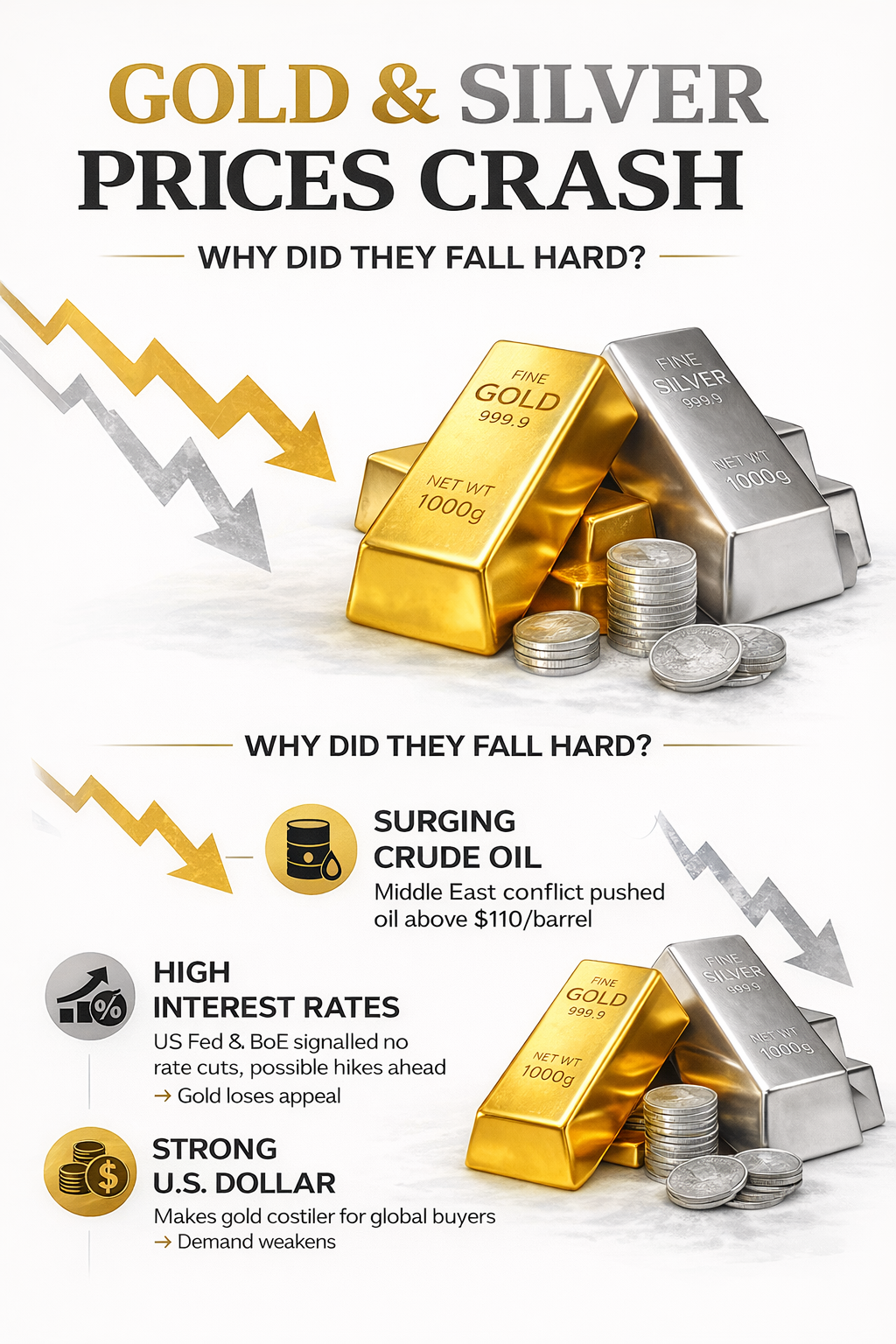
Gold and silver are supposed to be safe places to park your money when the world gets messy. Wars, inflation, political uncertainty-these are the things that normally push people towards buying precious metals. So it came as a shock to many investors when both gold and silver fell sharply-not by a little, but by some of the biggest margins seen in nearly four decades. Gold lost more than 10% in a single week-its steepest weekly drop since February 1983. Silver was hit even harder, falling sharply from its all-time highs reached in January 2026. In India, gold prices on the MCX dropped significantly from peaks earlier this year. Silver also saw a substantial correction from its January highs. These are not small moves. For ordinary buyers and investors, this correction came fast and felt brutal.
Why Did Prices Fall So Hard?
A few things came together at the same time, and each one made the situation worse. The conflict in the Middle East, now in its fourth week or more, pushed crude oil prices above $110 a barrel at times. When oil gets expensive, everything else gets expensive too-shipping, manufacturing, everyday goods. That pushes up inflation. Here is the problem: gold does not pay interest or dividends. When interest rates are expected to stay higher for longer-because central banks are trying to cool inflation-people move their money into assets that do pay returns, like bonds and deposits. Gold becomes less attractive by comparison. Central banks, including the US Federal Reserve, have signalled they are not planning to cut rates anytime soon, with markets pricing in limited easing. In fact, higher inflation fears from oil have reduced expectations for rate cuts. On top of that, the US dollar stayed relatively strong. A strong dollar makes gold more expensive for buyers using other currencies, so global demand cools. Stock market pressure also pushed some investors to sell their gold holdings to cover losses elsewhere-a situation analysts call margin-call selling. All of this combined to create a perfect storm for precious metals.
Where Do Prices Stand Right Now?
As of late March 2026, gold in India is trading around Rs 1,37,000 to Rs 1,42,000 per 10 grams on the MCX (with recent sessions showing levels near Rs 1,37,500–1,41,500). Silver is trading around Rs 2,00,000 to Rs 2,25,000 per kilogram. Internationally, spot gold is hovering near $4,300–$4,500 per ounce, having fallen from a record high near $5,600 reached in January 2026. Silver in global markets is around $66–$68 per ounce. Other precious metals have not been spared either. Platinum and palladium also faced pressure. Silver and gold ETFs-funds that track the price of these metals-saw sharp declines, giving retail investors who held these funds a rough ride.
What Analysts Are Saying
Experts are divided on what happens next, though most expect some short-term turbulence before things settle. Some analysts expect gold to consolidate and recover slightly before its next big move in either direction. Others believe gold will trade in a moderately bearish to sideways range, with the strong dollar and elevated interest rates capping any meaningful recovery. Certain analysts suggest the downside may not be over yet. They indicate gold could slide further to lower levels on the MCX, while silver may weaken more. That would represent another significant fall from current levels. However, there is also a more hopeful note. Analysts point out that the 200-day moving average for gold-a key technical level that traders watch-sits around $4,100–$4,300 per ounce, which could act as a floor. Meanwhile, global central banks are unlikely to reduce their long-term gold reserves, which keeps structural demand intact.
Should You Buy, Hold, or Sell?
This depends on your situation and time horizon. For traders looking for quick gains, most analysts advise waiting for prices to stabilise before taking fresh positions. Jumping in during heavy volatility can be risky, as prices may swing sharply in either direction. For long-term investors, especially those who buy gold and silver in small amounts regularly, the picture is different. Historically, precious metals tend to recover after such corrections. Analysts have described the current dip as a potential opportunity for staggered entry by long-term buyers. Small investors may continue gradual accumulation through a SIP-style approach. Seasonal factors also favour domestic demand in India. The upcoming wedding season and festivals like Akshaya Tritiya typically drive jewellery buying, which could provide some support to prices in the near term.
The Bigger Picture
What is happening with gold and silver right now reflects a broader tension in global markets. On one side, there is genuine uncertainty-an ongoing conflict, rising oil prices, and inflation that refuses to cool quickly. On the other side, higher interest rates and a firm dollar are making it harder for non-yielding assets to hold their value. Gold has not lost its relevance. It remains the asset most people turn to when things get difficult. But in the short term, the math of interest rates and currency strength is winning over the emotion of safe-haven buying. Whether that balance shifts in the second half of 2026 remains to be seen. For now, patience, and perhaps gradual accumulation, seems to be the sensible approach for those with a longer horizon.